CA LICENSE #1091603 · BONDED · WORKERS' COMPMON–SAT 7AM–7PM · 24/7 EMERGENCY
  1. Home
  2. Trees
  3. Jacaranda

The species file · jacarandas

Everyone loves a jacaranda in June. July gets complicated.

For six weeks a jacaranda is the best-looking thing in the neighborhood — a purple cloud you can see from three streets over. Then the flowers come down sticky, the fast-grown limbs remember they're brittle, and the fern-leafed umbrella needs an actual plan. Jacaranda owners never want the tree gone; they want June without the cleanup bill. Most of that is achievable.

FREE ESTIMATES · NO DEPOSIT · NO OBLIGATION

#1091603CSLB LICENSE — ACTIVE
$25,000CONTRACTOR'S BOND
State FundWORKERS' COMP ON FILE
5.0GOOGLE · 50 REVIEWS
20+YEARS OF EXPERIENCE

Know your tree

Is this the tree in your yard?

In bloom, it identifies itself from a distance. The rest of the year, look for the softest texture on the block — a tree that reads more like a giant fern than a hardwood.

01
Foliage

Finely divided, feathery leaves — the fern-tree nickname is earned. Briefly bare in late winter, often just before the bloom.

02
The bloom

Clusters of lavender trumpet flowers covering the crown before and with the new leaves — and then covering everything under it, stickily.

03
Seed pods

Flat, round, woody castanets that rattle on the branches and linger for a year — the off-season fingerprint.

04
Form

Arching scaffolds spreading into a wide, irregular umbrella, usually on a slightly leaning trunk — graceful by design, end-heavy by habit.

SPECIES FILE — JACARANDA

Botanical
Jacaranda mimosifolia
Mature size
25–50 ft, spreading wider than tall
Growth rate
Fast — and the fast wood is the soft wood
The show
Lavender-purple bloom, late spring into early summer
Watch for
Sticky flower drop · end-heavy limbs · frost burn on young trees
Also called
blue jacaranda · fern tree

What goes wrong

The trouble it causes here.

01

The sticky purple carpet

Jacaranda flowers drop wet, sugary, and constantly through the bloom — pasting themselves to cars, patios, and pool decks, and turning smooth hardscape slick where they mass. It's six weeks a year, it's the price of the show, and where the tree stands relative to where you park decides whether it's charming or infuriating.
02

Brittle wood at the ends

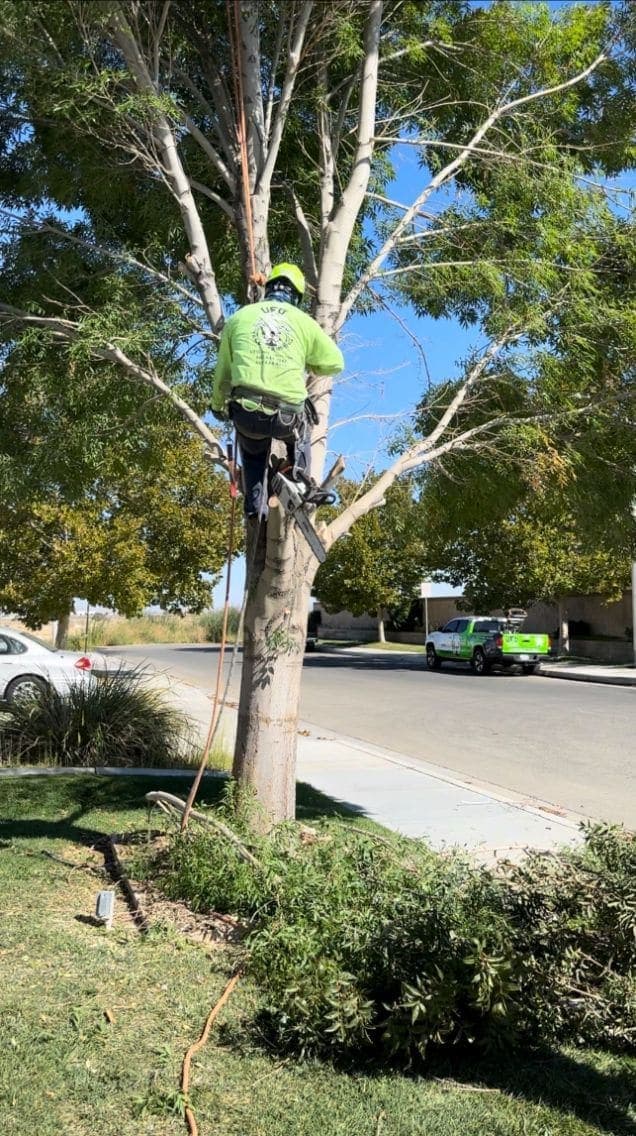
Jacaranda grows fast, and fast wood is soft wood. The failures are predictable: long arching scaffolds loaded at the tips, letting go in a gust or under the weight of a full bloom. End-weight reduction over targets is the single trim this species actually needs.

03

Hard pruning ruins the whole point

Cut a jacaranda hard and it answers with vertical watersprout thickets, ugly knuckles — and fewer flowers, since bloom rides on the mature wood you just removed. A topped jacaranda is a worse tree in every way the owner cares about. Light hands only.

04

The high desert is its northern edge

Jacarandas are frost-tender, and Antelope Valley winters test them — young trees burn back in hard snaps, and the species does its best work here in warm pockets, courtyards, and against south walls. Over the pass in Santa Clarita and the San Fernando Valley it's fully at home.

05

Roots and lawns disagree

Shallow roots ridge lawns and tilt nearby pavers as the tree matures — mild by ficus standards, real by lawn standards. Mulch under the canopy beats turf under the canopy, for both parties.

How we work it

How we handle this tree.

Jacaranda work is restraint work: protect the bloom, manage the tips, and never let anyone talk you into 'cleaning it up' with big cuts. This is a tree people love — the job is keeping it lovable.

01
Prune light, right after bloom

The window is early summer, once the purple is done — structure and clearance cuts sized small, so next year's flowering wood stays on the tree and the crown keeps its umbrella.

02
Weight off the tips

End-weight reduction on the long arching scaffolds over driveways, roofs, and patios — the brittle-failure insurance, done without changing the tree's silhouette.

03
Train the young ones

Early structure — one clean trunk, well-spaced scaffolds — is cheap and permanent on a fast species. So is smart siting advice: warm pocket, south exposure, parking out of the drop zone.

04
Rescue the mistreated

Topped jacarandas get the mulberry treatment: pick the best sprouts, grow them back into real limbs over a couple of visits, and retire the knuckles. The bloom comes back with the structure.

PUBLISHED PRICES — IN WRITING

Nearly all jacaranda work is trimming — the published $150–$800 per tree, and the light-touch scope keeps most visits mid-range. Removals are rare (usually a freeze-killed young tree or a genuinely wrong spot) and follow the published tiers, $300–$900 small and $700–$1,800 medium, plus $300–$600+ if the stump goes too.

See what your job costs →

RANGES FROM OUR 2026 COST GUIDE · EXACT QUOTE IS FREE, ON-SITE

Straight answers

Asked constantly.

Real questions from Antelope Valley phone calls — answered the same way we answer them on your driveway.

STILL WONDERING?Ask a human instead.661-644-7347

Right after the bloom finishes, in early summer — the tree gets the whole growing season to close small cuts, and you don't sacrifice next June, because flowers ride on mature wood. Winter pruning costs you bloom; hard pruning any time costs you the tree's shape. Light and post-bloom is the whole recipe.

The usual suspects, in order: it got pruned hard in the past year (bloom rides mature wood), a cold snap caught the buds, it's young and still building, or it's living too well — a jacaranda in a fertilized, well-watered lawn grows leaves instead of flowers. A lean year after any of those is normal; we can tell you which one yours had.

Established trees in town generally do — urban yards, courtyards, and south walls carry them through most winters, and there are handsome mature jacarandas around the Valley to prove it. Young trees are the vulnerable ones: expect some frost burn in hard years and protect them their first few winters. Over the pass, no asterisks needed.

For the six weeks of bloom: park somewhere else, honestly — the drop is constant, sticky, and hard on paint if it bakes. Rinse promptly, don't let it dry in the sun. Pruning can pull the canopy back off the driveway edge, and that's a reasonable, light cut. What we won't do is gut the crown to save a parking spot — that trade always ends with a sad tree and the same sticky car.

Priority dispatch

Emergencies jump the queue. 24/7.

A split trunk or a tree on your roof doesn't go on a waitlist. Emergency calls get the next available crew — any hour, any day — and you reach the crew, not a call center.

661-644-7347
I need emergency tree removal

24/7 · LICENSED #1091603 · BONDED · WORKERS' COMP ON FILE

Not sure it's an emergency? Here's what counts →