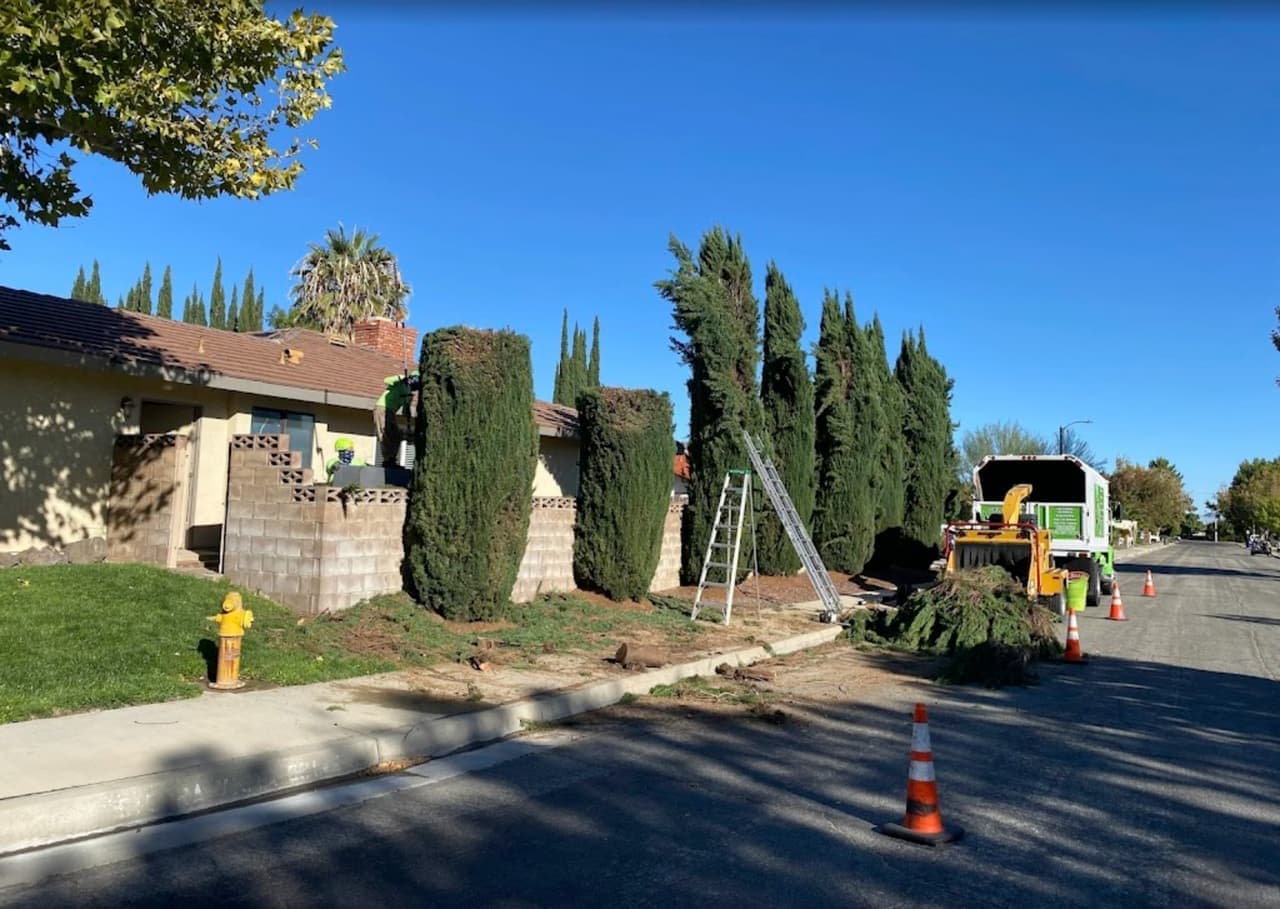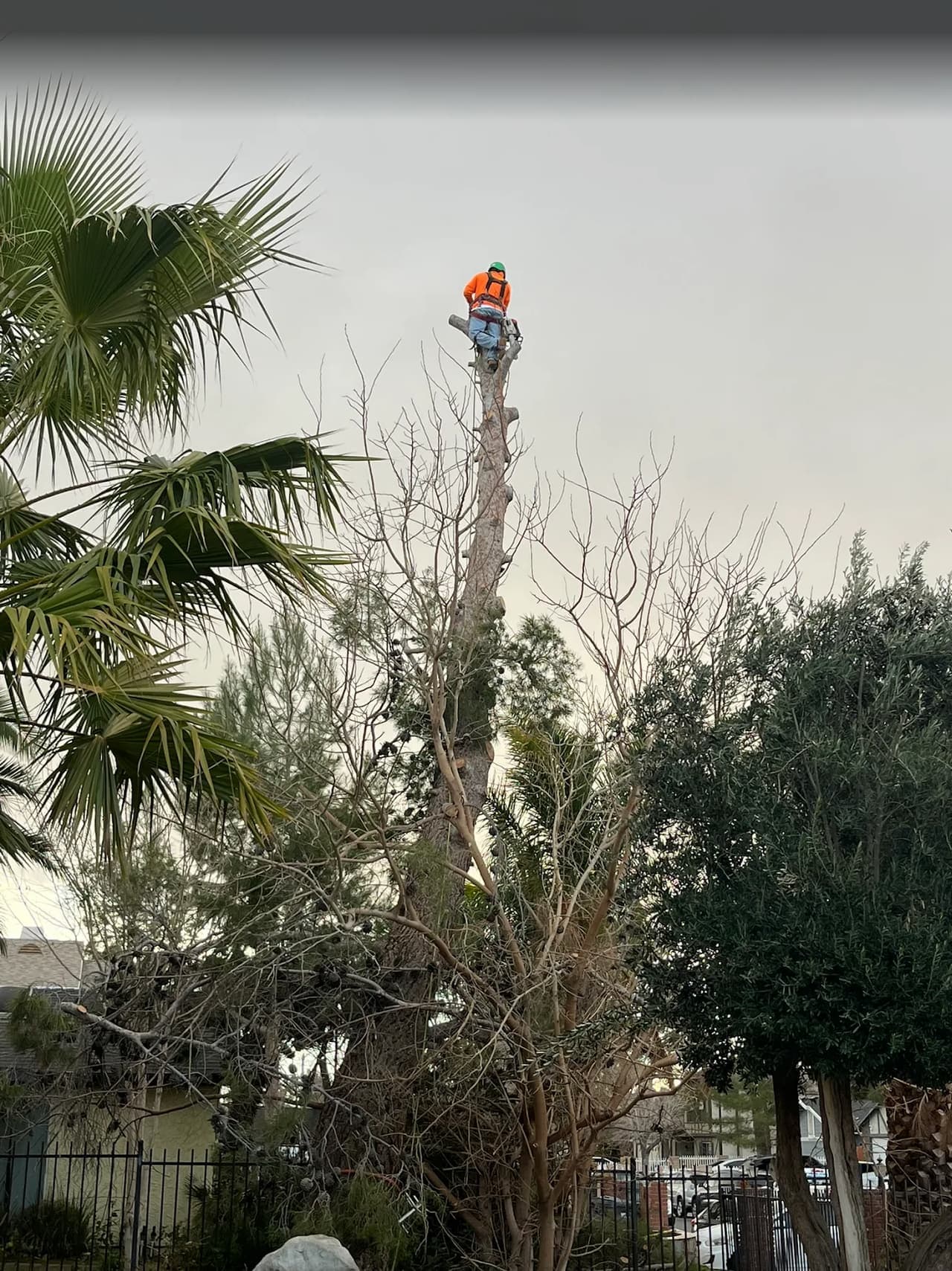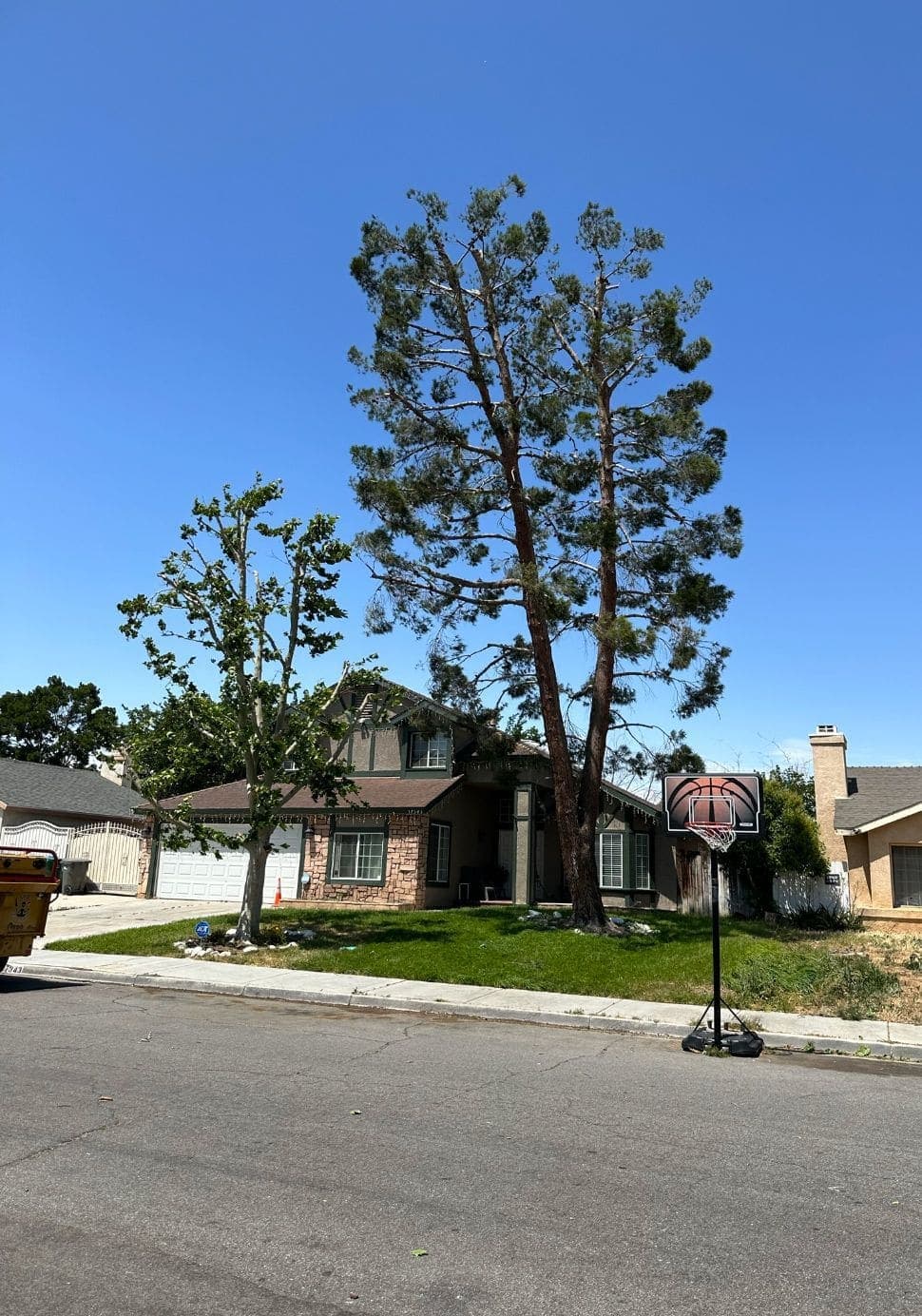
It's one of the most common calls we get in Palmdale, Lancaster, and the surrounding desert communities: a homeowner looking up at a big tree, not sure whether it needs pruning or needs to come out. The answer is rarely obvious from the street. Most of the big tree mistakes we see happen because a tree got judged on appearance instead of structure, risk, and long-term behavior. We've seen healthy-looking trees that were structurally unsafe, and messy-looking trees with decades of safe life left in them.
The real decision always comes down to one question: what problem are we actually solving — health, structure, or safety?
When Pruning Is the Right Answer
Most trees people think need removal actually just need proper pruning. Antelope Valley wind, heat, and long dry seasons produce a lot of trees that look worse than they really are.
Pruning is usually enough when:
- The tree is overgrown but structurally sound
- Branches hang over roofs, driveways, or fences
- The canopy carries excessive weight or wind resistance
- Deadwood has built up
- The tree simply hasn't been maintained in years
What homeowners usually say: "It's too big." "It looks like it's going to fall." "It's hanging over my house."
What's usually actually going on:
- Long, heavy limbs from years without pruning
- A dense canopy catching wind
- Minor deadwood buildup
- No recent structural maintenance
Proper structural pruning can:
- Reduce wind load
- Take excess weight off overloaded limbs
- Improve clearance over structures
- Restore balance and structure
- Add years to the tree's safe life
In many cases, pruning delivers exactly what the homeowner wanted — without losing a mature shade tree.
When Removal Is the Right Answer
Some situations are past pruning. Not because the tree looks bad — because the structure is no longer reliable.
1. Severe trunk decay or structural failure
Warning signs:
- Cavities or hollow sections
- Cracks in the trunk
- Fungal growth at the base
- Multiple splitting stems
If the main structure is compromised, no amount of pruning restores its strength.
2. Root system failure or instability
Signs:
- A lean that developed recently
- Soil lifting or cracking
- Exposed or damaged roots
If the roots are failing, the tree's anchoring system is already compromised.
3. Advanced decline
- Large portions of the canopy dead
- Years of progressive thinning
- Repeated branch failure
- Ongoing deterioration
At this stage, pruning delays removal — it doesn't reverse the decline. When a tree reaches this point, removal is usually the safest long-term call. Our tree removal services cover how we evaluate hazardous trees and take them down safely.
How We Evaluate Trees in the Field
When we walk a property in Palmdale or Lancaster and someone asks "prune or remove," the process is the same every time.
- First: what could it fall on? We look at targets before anything else — house, garage, vehicles, power lines, high-traffic areas. A moderate defect becomes a serious one depending on what's underneath it.
- Overall structure. From a distance: lean, canopy imbalance, dead sections, broken tops, and how the weight is distributed.
- Trunk and main branches. The most important structural check: cavities, cracks, weak branch unions, signs of decay. If this structure is compromised, pruning has hard limits.
- Root system. Soil lifting, root exposure, construction damage, irrigation issues. Root failure is one of the most serious risk indicators there is.
- Canopy health. Percentage of deadwood, the pattern of decline, leaf density, and stress growth.
- Species behavior. Different trees behave differently out here: ash is often highly salvageable, Chinese elm is very resilient, eucalyptus is structurally unpredictable, cottonwood gets decay-prone with age, and pine raises stability and root-sensitivity concerns.
- Risk vs. value. It ends with one question: does pruning meaningfully reduce the risk and extend the life of this tree? If yes — prune. If no — remove.
How Homeowners React to a Removal Recommendation
Most homeowners who push back aren't disagreeing — they just can't see the risk yet. The usual reactions:
- Surprise: "It looks fine though."
- Frustration: "Another company said it just needs trimming."
- Concern: "Is it going to fall soon?"
- Relief, after we walk them through it: "I didn't realize that."
Once the structural issues are pointed out and explained, most people understand the recommendation clearly.
Cost: The Factor That Drives Most Decisions
In practice, cost decides a lot of these calls — but it should always be weighed against the long-term outcome.
Pruning is the cost-effective move when:
- The tree is structurally sound
- The issues are mainly maintenance-related
- The goal is preservation and longevity
Removal is actually cheaper long-term when:
- Repeated pruning would be required just to hold the line
- Structural failure is progressing
- The risk of damage or an emergency removal is high
Sometimes the cheapest decision today becomes the most expensive one over time.
Common Mistakes Homeowners Make
Most regrets come from timing, not bad decisions:
- "It still looks green, so it must be fine"
- Choosing light pruning when structural pruning was needed
- Waiting too long to act
- Overestimating how long a weakened tree will stay standing
In the Antelope Valley, wind, heat, and drought stress can change a tree's condition quickly.
Understanding Urgency
Not all tree issues carry the same clock.
Immediate action:
- Cracks in major limbs or the trunk
- Sudden leaning
- Root plate movement
- Partially failed limbs
Address soon:
- Heavy deadwood
- Overextended limbs
- Early structural decline
Routine maintenance:
- Healthy structure
- Minor deadwood
- Normal shaping needs
Urgency determines more than timing — it determines whether pruning is even still a viable solution.
Long-Term Tree Care in the Antelope Valley
Good tree care prevents emergencies before they start. A typical maintenance schedule:
- Inspection: every 1–2 years
- Pruning: every 2–4 years (varies by species)
What prevents removals later:
- Early structural pruning
- Managing canopy weight
- Monitoring root and soil conditions
- Consistent watering
The biggest mistake: waiting until a tree "looks bad" instead of addressing early structural changes.
Final Philosophy
One principle covers all of it:
If a tree can be safely preserved with pruning, we preserve it. If pruning only delays an unavoidable failure, removal is the responsible choice.
Trees are worth a lot in the Antelope Valley — shade, property value, livability in extreme heat. They're also under constant stress from wind, drought, and temperature swings. The job isn't to save every tree or remove every risky one. It's to make the most honest call based on structure, not appearance.
Final Takeaway
A healthy-looking tree can be structurally unsafe, and a messy-looking tree can be completely recoverable. That difference is what separates routine maintenance from emergency tree work — and most major tree problems don't start as emergencies. They build slowly through missed warning signs.
UFO Tree Trimming is a locally based tree service serving Palmdale, Lancaster, and the greater Antelope Valley. The approach is simple: honest evaluations, safety-first recommendations, and long-term tree health and structure — real risk assessment, not just trimming. We tell homeowners the truth about their trees, even when that means recommending pruning instead of removal.