Trees in Palmdale, Lancaster, Quartz Hill, Acton, and across the Antelope Valley don't fail the way trees do in milder climates. High desert wind, long dry seasons, compacted soil, and aging residential landscapes push trees from "looks fine" to structurally unsafe faster than most homeowners expect. Work enough trees out here and one pattern holds:
Most hazardous trees don't look dangerous until they're already close to failure.
That's why early warning signs matter more than appearance. Here are the five situations where a tree moves from routine maintenance into potential removal territory.
1. Cracks or Splits in the Trunk
A trunk crack is one of the clearest structural warnings there is, because it means something inside has already failed. We see them most in older or fast-growing trees that were never built for long-term structural stability.
The crack itself isn't the whole problem — it's what it represents. The tree is no longer distributing weight safely through its structure, and once that's true, pruning can't restore structural integrity. Trunk defects often overlap with the other signs on this list; our guide on tree pruning vs tree removal in Palmdale & Lancaster breaks down where pruning stops being enough.
2. Branches Falling Without a Weather Event
A branch that drops on a calm day is a strong indicator of internal stress. We see it most in trees carrying long-term drought stress or years of inconsistent irrigation — both common across the Antelope Valley.
Pruning at this stage can knock down the immediate hazard. But if the problem is systemic, it won't stop the decline.
3. A Lean That's Getting Worse
A stable tree can lean for years without issue. What matters is change.
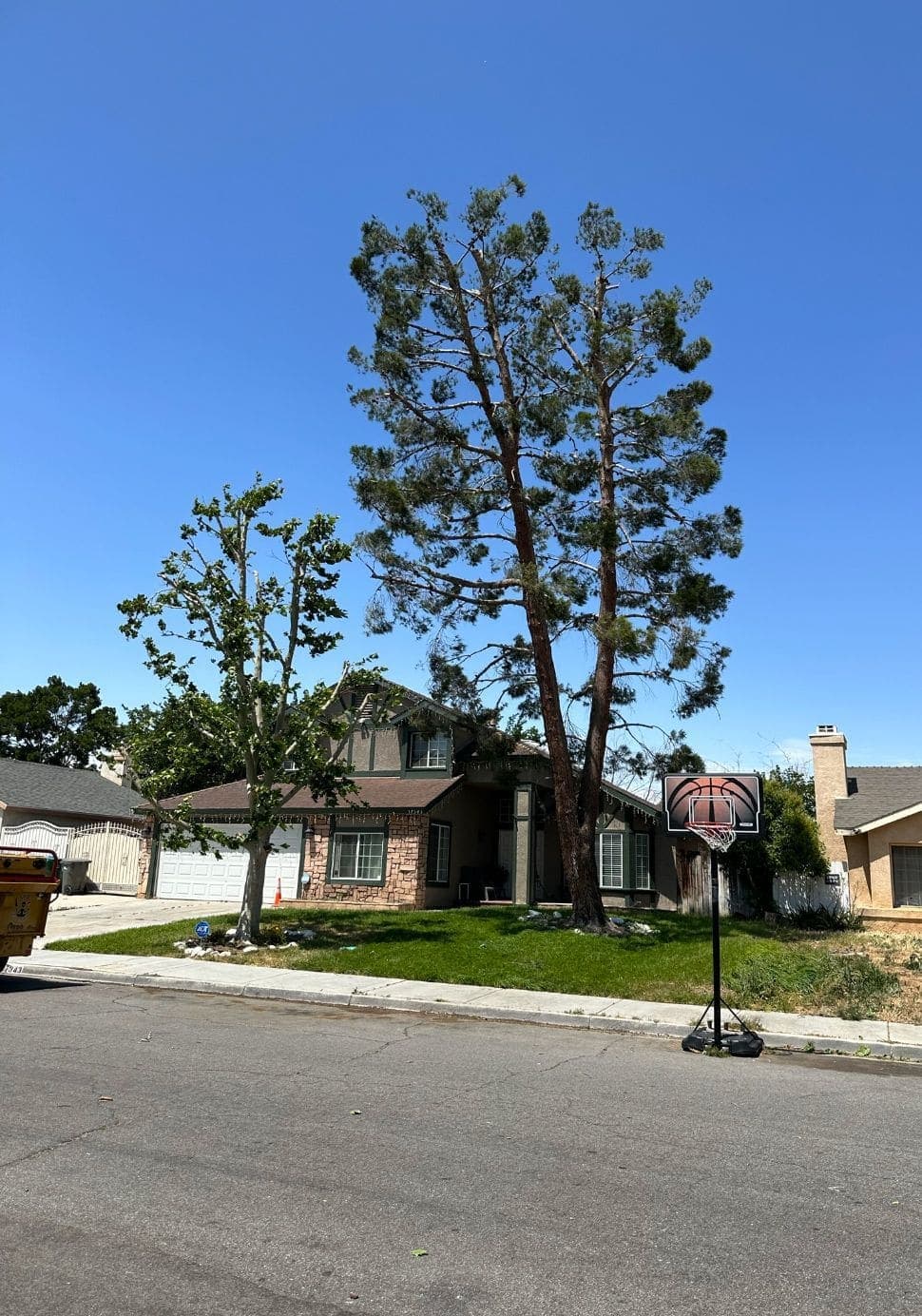
A lean that's increasing usually signals root instability — soil movement, irrigation changes, or root damage. These are the trees that still look healthy but are no longer reliable under wind load. In those cases, removal before natural failure is often the safest option; leaning trees over unstable roots are among the most common causes of emergency removals.
4. Root Zone Disturbance or Lifting Soil
Root damage is as serious as it gets, because the roots are the tree's entire structural foundation. Most homeowners don't notice root trouble until it surfaces: lifted soil, cracking around the base, exposed roots.
Construction, grading, and irrigation changes are the usual causes in Palmdale and Lancaster neighborhoods. Once the root system is compromised, pruning can't restore stability — the structural base of the tree is already affected.
5. Disease, Decay, or Internal Hollowing
Decay is the most deceptive condition on this list, because a tree can stay green while it deteriorates from the inside. Fungal growth, hollow sections, peeling bark, and soft wood all point to internal breakdown.
By the time decay is visible from the outside, structural strength is usually already significantly reduced.
How Tree Decisions Are Actually Made in the Field
An evaluation in Palmdale or Lancaster never starts with "remove or prune." It starts with risk:
- What would this tree hit if it failed?
- Is the structure still reliable under wind load?
- Is the issue isolated or systemic?
- Can pruning realistically reduce the risk?
This is where experience matters most, because two trees that look nearly identical can have completely different structural outcomes. We see it constantly in the borderline cases covered in our guide on when pruning is enough vs when removal is required.
One tree responds well to pruning and stays safe for years. The other is already approaching failure. That difference sets the recommendation.
When Structural Decline Is Beyond Pruning
At the far end of decline, the problems stack:
- Trunk defects
- Root instability
- Canopy dieback
- Repeated branch failure
When several of these show up together, pruning only delays the inevitable. At that point, removal is the responsible long-term answer.
Final Takeaway
In the Antelope Valley, tree risk isn't always visible from the ground. Some dangerous trees still look healthy, and some messy-looking trees are structurally sound. The decision comes down to structure, stability, and failure risk — not appearance.
An early evaluation always beats waiting for a collapse or a windstorm to decide for you. If a tree is showing any of these warning signs, the safest step is a professional evaluation before conditions get worse.