Homeowners throughout Palmdale, Lancaster, Quartz Hill, Acton, Littlerock, Rosamond, and the rest of the Antelope Valley ask us the same question:
"How much does tree trimming cost?"
The honest answer is that tree trimming isn't priced by the tree alone. The cost depends on how much work the tree actually needs, its condition, the difficulty of reaching it, the safety measures involved, and what it takes to clean up afterward.
Two trees can look identical from the street and cost very different amounts once we get close enough to evaluate them.
One may need a simple maintenance trim. The other may require climbing, rigging, and extra precautions because it's over a roof, a fence, a vehicle, or a pool.
Our published range for residential trimming is $150–$800 per tree. Where your tree lands inside that range is what the rest of this guide explains. If you want the number before the explanation, the instant estimator gives you a range for your job in about a minute.
What Actually Moves the Price
A common misconception is that trimming is priced by height.
Height matters, but it's one input among many. The factors that move a quote the most:
- How much pruning the tree actually needs
- Species and structure
- The tree's health and condition
- Access to the work area
- Whether limbs sit over roofs, fences, pools, vehicles, or power lines
- How much debris the job creates
- Whether branches have to be rope-lowered instead of dropped
- Cleanup and hauling
- Whether several trees can be done in the same visit
Sometimes three small trees cost less than one difficult tree that demands extra safety measures.
Small Trees
Trees up to roughly 20 feet are usually simpler to maintain and sit at the lower end of the published range.
Common examples in the Valley:
- Young fruit trees
- Smaller ornamentals
- Desert willow
- Smaller crape myrtle varieties
Typical work includes removing deadwood, light shaping, improving clearance around walkways, and basic canopy maintenance.
Even on small trees, technique matters. Removing the wrong branches affects how the tree grows for years afterward.
Medium Trees
Medium trees take more planning, more cleanup, and sometimes climbing equipment — so they sit further into the range.
Common examples:
- Chinese elm
- California pepper
- Pistache
- Ash
These are everywhere in Palmdale, Lancaster, and the surrounding communities. Work usually means removing deadwood, raising lower branches, reducing weight from heavy limbs, correcting overgrown growth, and improving clearance from roofs and driveways.
A tree in this category is often perfectly healthy. It just hasn't been maintained in years.
Large Trees
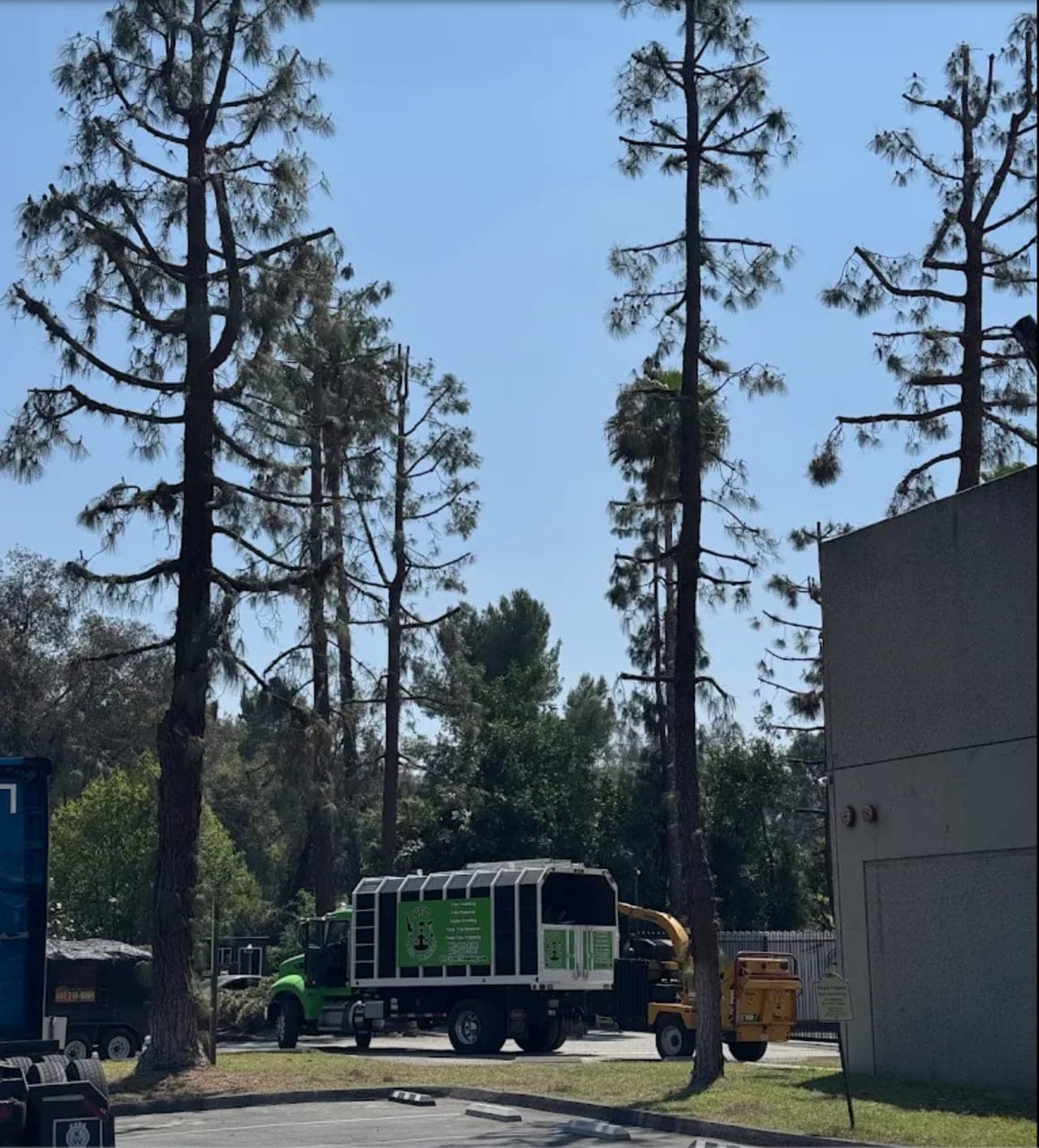
Large trees demand more experience, because size, weight, and limb placement all add risk. These jobs sit at the top of the published range, and the most technical ones go above it.
Common examples:
- Mature pines
- Eucalyptus
- Large sycamores
- Mature oaks
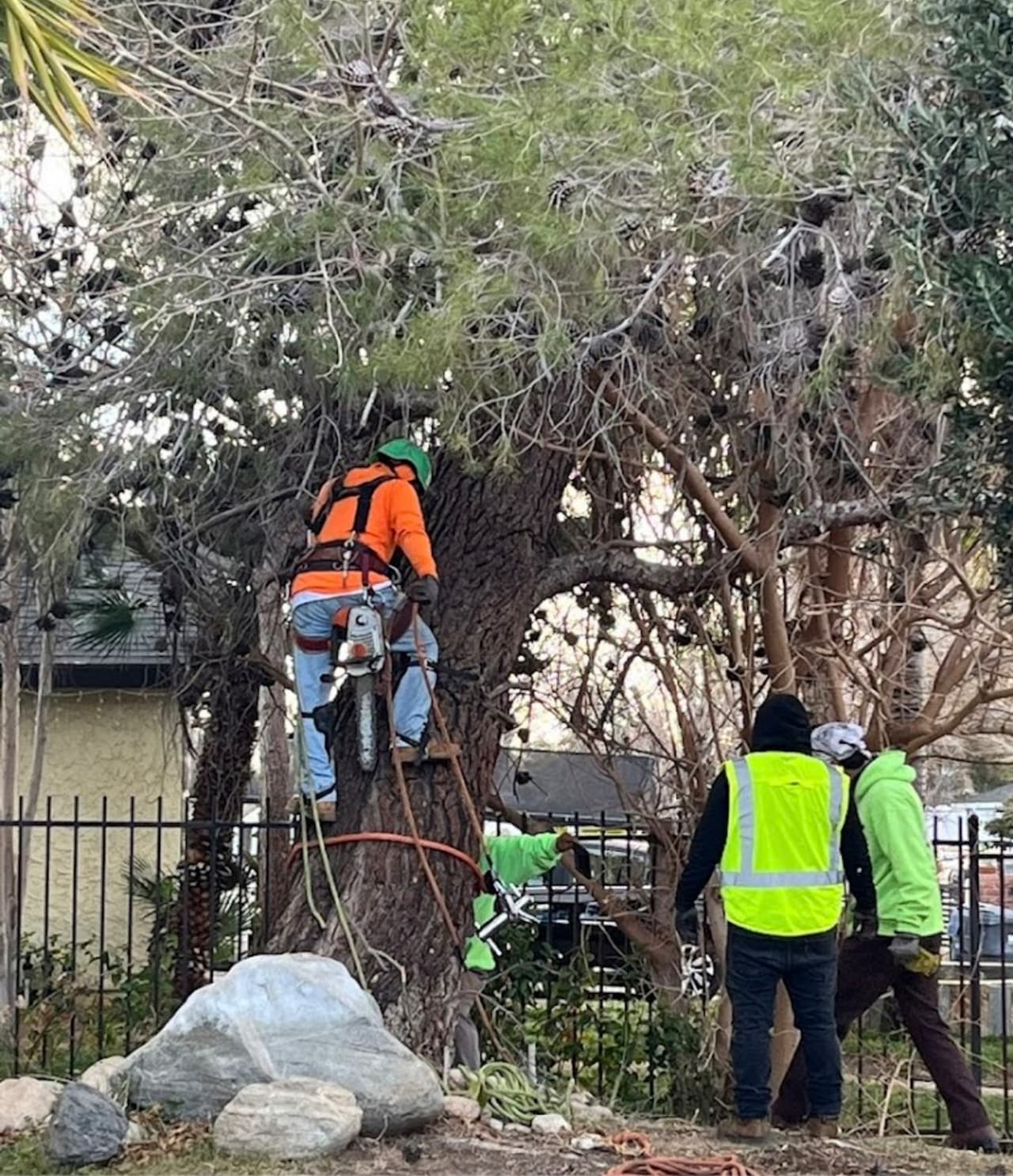
Large-tree work may involve professional climbing, rigging ropes, controlled limb lowering, additional crew, and significantly more cleanup and hauling.
A big tree in an open yard can be straightforward. The same tree growing over a roof is a different job entirely.
Palms
Palm pricing depends on height, how many palms, how much dead material has built up, access, and cleanup.
A single short palm is a quick job. A 60-footer over a pool is climbing time, and a trunk carrying a decade of unskinned thatch is slower work than a maintained one. Palm work follows the same published per-tree range, with height being the biggest single factor.
Real Examples From the Antelope Valley
A Chinese Elm in Lancaster
A homeowner called because their Chinese elm hadn't been professionally maintained in several years. The branches were growing toward the roof, throwing heavy shade, and dropping constant debris.
The tree itself was healthy. It didn't need removal.
We removed deadwood, raised the canopy, improved roof clearance, and selectively thinned the growth.
The lesson: many overgrown trees don't need to come down. They need the right maintenance.
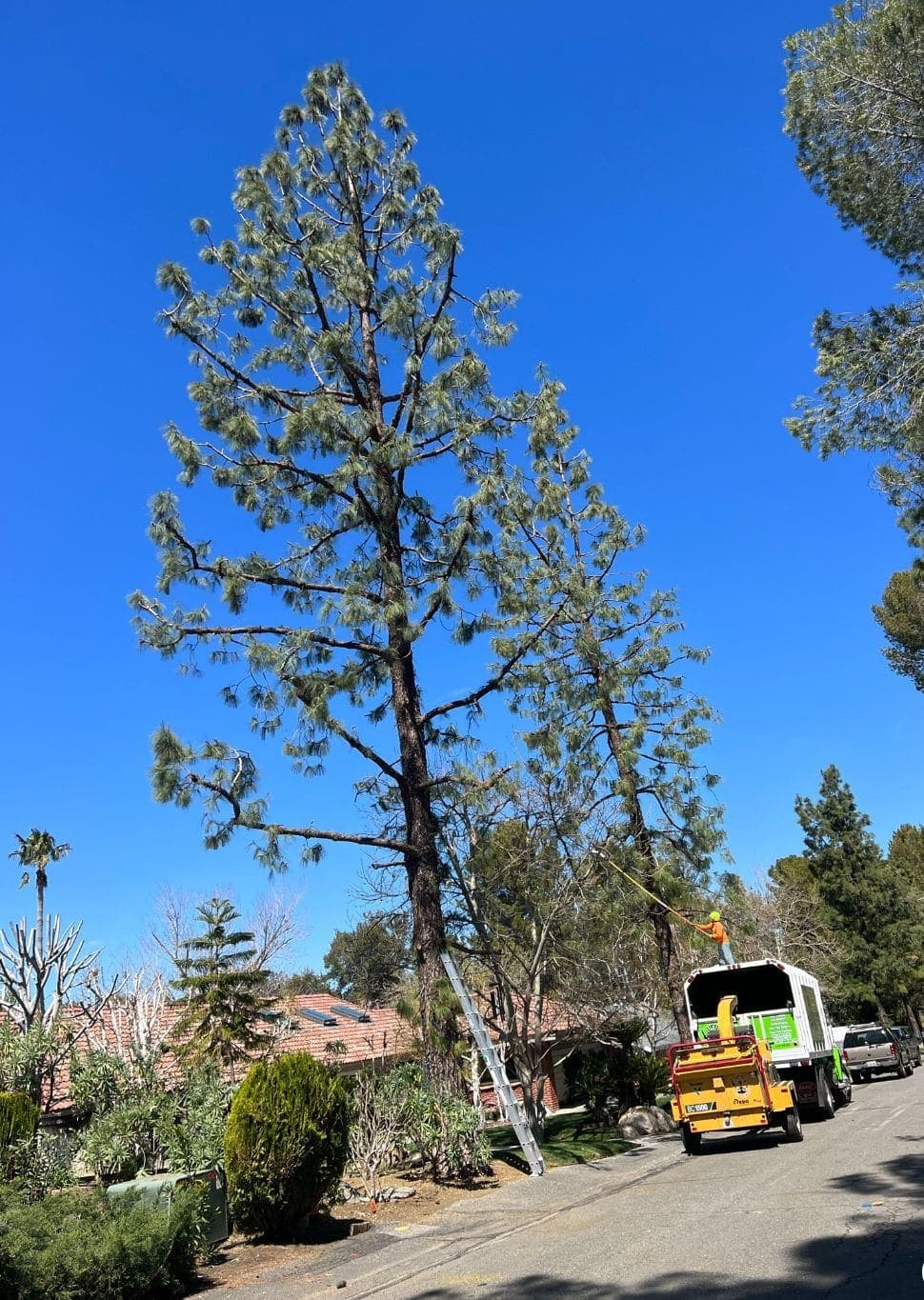
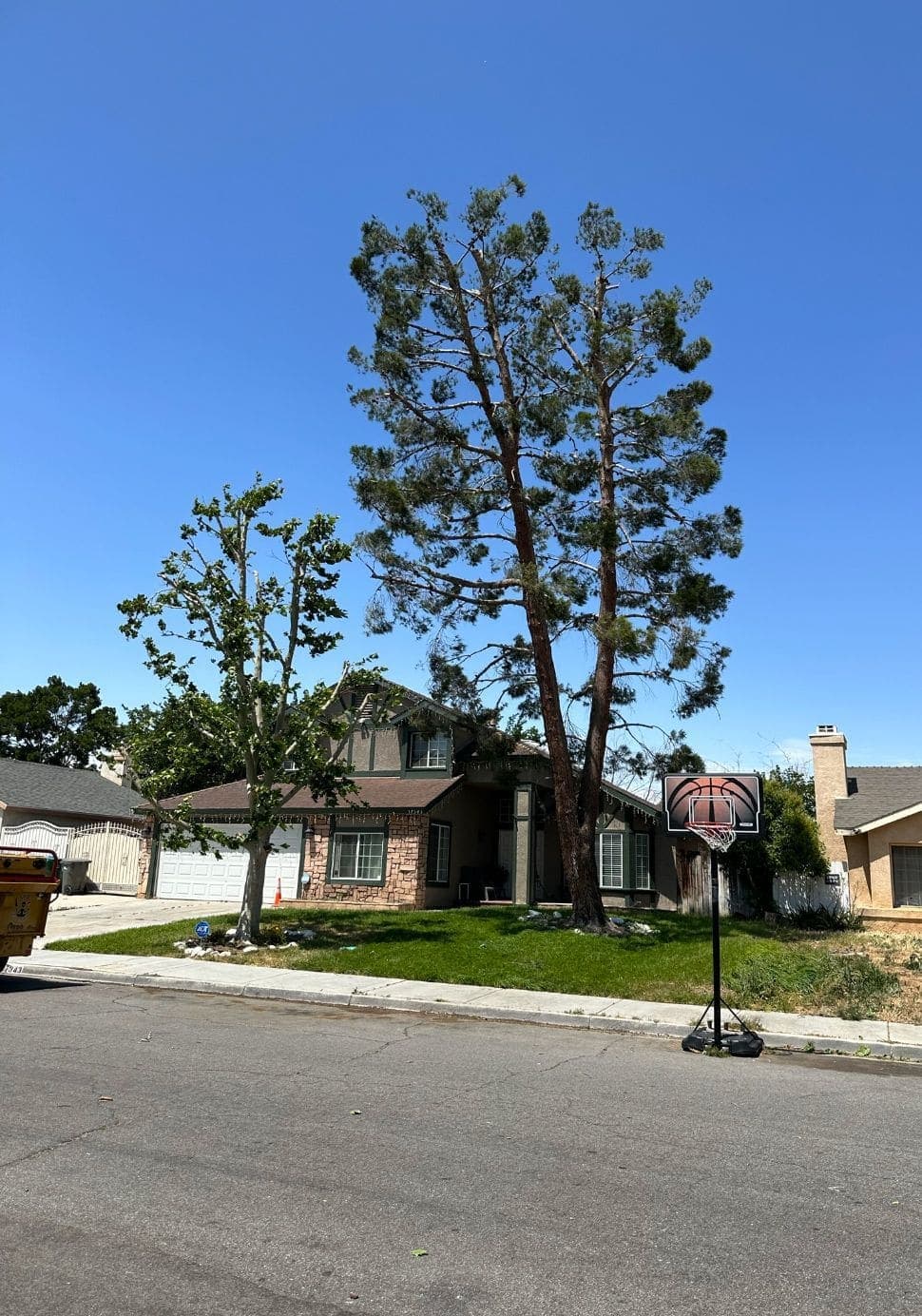
A Pine in Palmdale
A homeowner had a mature pine with heavy limbs extending over a patio and fence.
The concern wasn't the tree's size. It was removing that weight without damaging what sat underneath.
Because those limbs couldn't simply be dropped, we used controlled rope-lowering. The job needed careful planning, additional safety measures, and thorough cleanup — and it priced accordingly. The cost came from complexity, not height.
A Pepper Tree in Quartz Hill
A pepper tree that hadn't been touched in years had dense interior growth, heavy limbs, low branches blocking access, and uneven shape.
Instead of removing it, we did structural pruning, selective thinning, deadwood removal, and clearance trimming.
The homeowner was surprised how much better it looked while keeping its shade and natural form.
Why We Don't Quote Exact Prices Over the Phone
When someone calls, we know they want a number immediately.
The problem is that a tree can't be judged accurately from a description or a photo.
A homeowner might say "it's just a few branches." Those branches could be large and heavy, hanging over a roof, near a fence or vehicle, hard to access, or genuinely unsafe to remove without the right equipment.
Before recommending anything, we look at structure, overall health, branch placement, safety concerns, property conditions, and cleanup requirements. That's what makes an estimate honest instead of optimistic.
Sometimes the evaluation shows trimming isn't the right answer at all. If a tree has serious structural problems or can't be safely maintained, removal may be the better call — our guide on what really determines tree removal price covers that side.
Why Local Experience Matters
Tree care here isn't like tree care elsewhere. Antelope Valley trees deal with extreme summer heat, dry conditions, strong seasonal winds, drought stress, and big temperature swings.
A company unfamiliar with this environment tends to approach every tree the same way.
Those conditions take a toll over time. Homeowners notice thinning canopies, dead branches, or a tree that simply looks different than it did last year — our guide on reducing the risk of tree diseases covers the common causes.
With 20+ years of experience on Valley trees, we've learned that different species need different decisions. A eucalyptus doesn't grow like a Chinese elm. A pepper tree doesn't respond like a fruit tree. A mature pine near a house needs different planning than a small ornamental in an open yard.
The goal isn't removing the most branches possible. It's improving safety, health, and appearance while protecting the tree's future.
The Mistake That Costs More Later
The biggest one we see is choosing a company on price alone.
A cheaper estimate can mean less experience, poor pruning technique, inadequate equipment, limited cleanup — and more problems later. We've been called out to correct trees damaged by improper trimming.
Tree work is more than cutting branches. Understanding branch weight, structure, and safe removal methods matters when you're working around a home. Our article on why professional tree trimming safety matters goes deeper.
The other mistake is waiting too long. A tree maintained every few years is easier and cheaper to care for than one neglected for a decade.
What You Get From Us
Our goal isn't to sell the biggest service. It's to recommend the right one — sometimes a simple trim, sometimes deadwood removal, sometimes structural pruning, sometimes a safety recommendation, and occasionally removal when a tree can't be safely kept.
Evaluate the tree. Explain the options. Do the work correctly.
A properly maintained tree adds shade, beauty, and value for many years.
If you'd like an experienced evaluation, call UFO Tree Trimming at 661-644-7347, or get your estimate started online.